



Science Friday 007: Endemic Species
Dive Curious. Discover what others miss.
Mission Recap
Imagine traveling halfway around the world to dive a coral reef, only to discover that some of the fish you encounter cannot be found anywhere else on Earth. Here in Hawaiʻi, we have the privilege of diving among these species every day. In fact, roughly one-quarter of Hawaiʻi’s reef fish species are endemic, meaning they only live in one place, on our islands’ reefs.
This Science Friday, we explored what makes Hawaiʻi’s marine ecosystem so unique, how geographic isolation has shaped the evolution of our reef fish, and why the same species we encounter on one island may be considerably less common on another.
An Ocean of Isolation
Hawaiʻi is one of the most geographically isolated island chains in the world. For marine life to establish itself here, it first had to overcome an enormous geographic barrier: thousands of miles of open ocean.
While many adult reef fish spend much of their lives on or around a particular reef, their offspring often begin life in the open ocean. During this larval stage, ocean currents can transport developing fish considerable distances before they settle onto a reef.
Over millions of years, some of these larvae successfully made their way to the Hawaiian Islands, established populations, and reproduced. With limited genetic exchange between these populations and those elsewhere in the Pacific, genetic mutations, natural selection, and genetic drift gradually shaped these isolated populations. In some cases, they became genetically distinct enough to be recognized as entirely new species.
This evolutionary process, known as speciation, has helped shape the marine biodiversity we see on our reefs today.
A Tale of Two Sergeant Majors
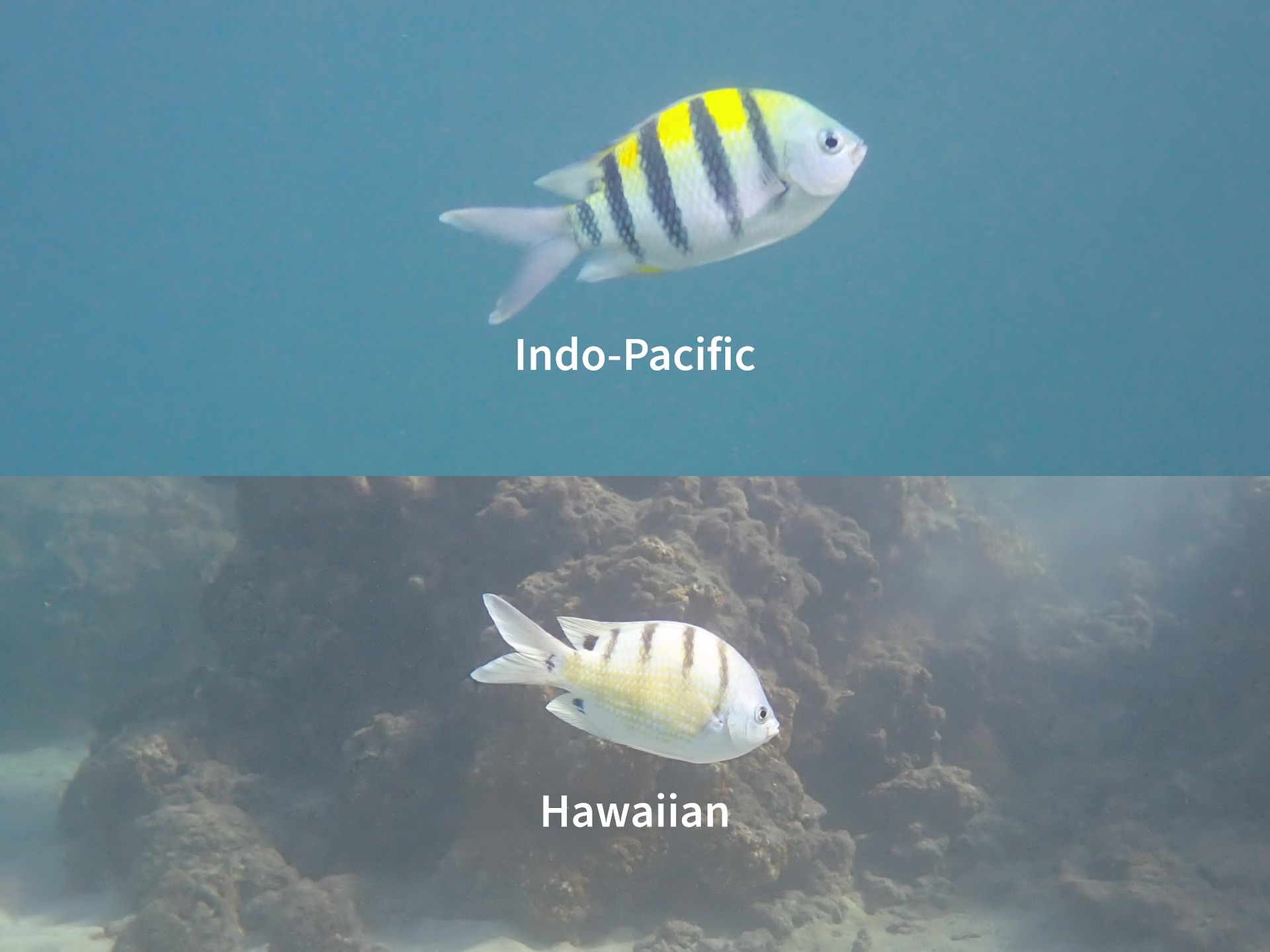
The Hawaiian Sergeant Major ( Abudefduf abdominalis ) and the Indo-Pacific Sergeant Major ( Abudefduf vaigiensis ) provide an interesting opportunity to explore both evolution and the consequences of reconnecting geographically separated species.
At first glance, these two members of the damselfish family look remarkably similar. Both have five dark vertical bars running down their bodies. Look a little closer, however, and you will begin to notice some differences.
The Hawaiian Sergeant typically has dark bars that taper toward its belly, with a greenish-yellow coloration along its lower body. The Indo-Pacific Sergeant generally has more pronounced dark bars and a brighter yellow coloration along its upper body.
While the Hawaiian Sergeant is endemic to our islands, the Indo-Pacific Sergeant is widely distributed throughout the Indo-Pacific and was first documented in Hawaiian waters in 1991.
What makes their story particularly interesting is that these two species can reproduce with one another, a process known as hybridization. Researchers have documented multiple generations of hybrids throughout the Hawaiian Archipelago, raising concerns that continued interbreeding could gradually diminish the genetic uniqueness of our endemic Hawaiian Sergeant.
After generations of evolution in geographic isolation, the very barrier that helped create a unique Hawaiian species is no longer keeping these two species apart.
A Lionfish That Belongs Here
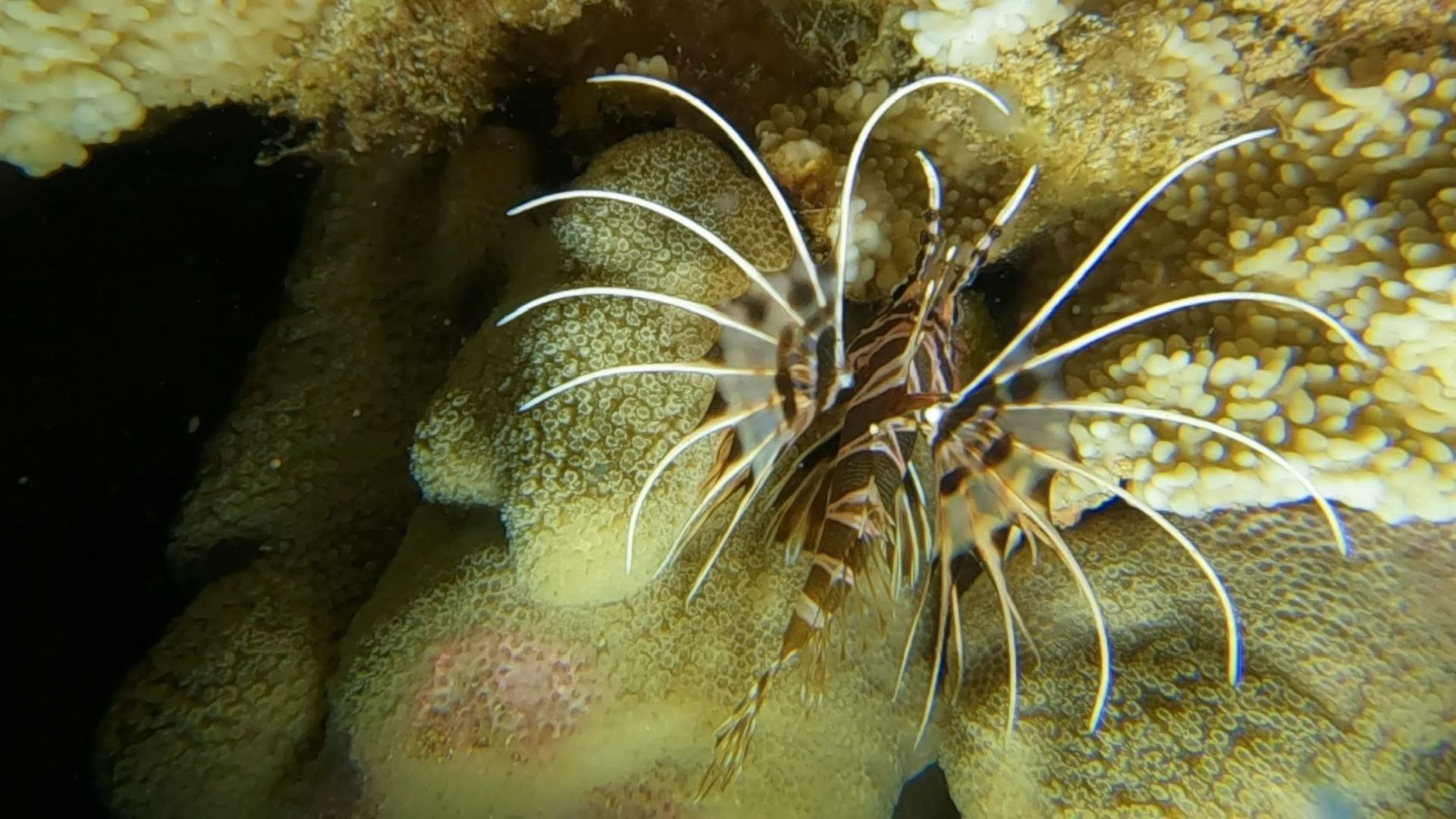
For those who have spent time diving in the Caribbean, the sight of a lionfish may immediately bring to mind an invasive species. Here in Hawaiʻi, however, the Hawaiian Red Lionfish ( Pterois sphex ), also known as the Hawaiian Turkeyfish, tells a very different story.
Endemic to Hawaiʻi, our red lionfish is considerably smaller than its invasive Caribbean relatives, typically reaching a maximum length of approximately 9 inches, compared to the 18 inches that some invasive lionfish can reach.
During the day, Hawaiian Red Lionfish are often found tucked beneath ledges or within the cracks and crevices of the reef. At night, they emerge to hunt, feeding primarily on small crustaceans.
The two lionfish species responsible for the Caribbean invasion, the Red Lionfish ( Pterois volitans ) and Devil Firefish ( Pterois miles ), are native to the broader Indo-Pacific region. Following their introduction into the western Atlantic, abundant prey, limited effective predation, and high reproductive rates allowed their populations to expand rapidly, placing considerable pressure on native reef fish communities.
All three species share similar physical adaptations, including venomous spines, elaborate pectoral fins, and predatory feeding strategies. Yet their ecological roles are very different.
Our Hawaiian Red Lionfish is part of an ecosystem that has developed alongside it over evolutionary time. The Caribbean’s invasive lionfish were introduced into an ecosystem that had no evolutionary history with these predators.
It is a great reminder that understanding an organism requires more than knowing what it is. We also need to understand where it belongs and how it interacts with the ecosystem around it.
What We’re Still Wondering
Why are some endemic Hawaiian fish more common on certain islands than others?
If a fish is endemic to Hawaiʻi, why might we regularly encounter it on one island but rarely see it on another?
Although we often think of the Hawaiian Islands as sharing one marine ecosystem, each island presents a different combination of environmental conditions.
Water temperature, reef structure, wave exposure, food availability, depth, and ocean currents can all influence where fish establish populations and how successful those populations become.
Ocean currents also play an important role in larval dispersal. While some larvae may be transported between islands, others may remain close to the reefs where they were spawned. This can influence the number of young fish entering local populations, a process known as recruitment.
Interestingly, researchers examining more than 5,300 reef fish surveys throughout the Hawaiian Archipelago found that endemic species accounted for approximately 17% of individual reef fish surveyed around Hawaiʻi Island, compared to 52–55% at the northern end of the archipelago.
The Masked Angelfish ( Genicanthus personatus ) is a particularly interesting example. Rarely encountered at recreational diving depths around the main Hawaiian Islands, this endemic species is more commonly found in shallower waters around Midway and Kure Atoll in the Northwestern Hawaiian Islands.
Could cooler water temperatures explain some of these differences? How much of a role does the availability of suitable habitat play? And how do ocean currents influence the distribution of fish between our islands?
While we know these factors influence fish distribution, understanding their relative importance for individual species presents an entirely new set of questions.
Look Beyond the Familiar
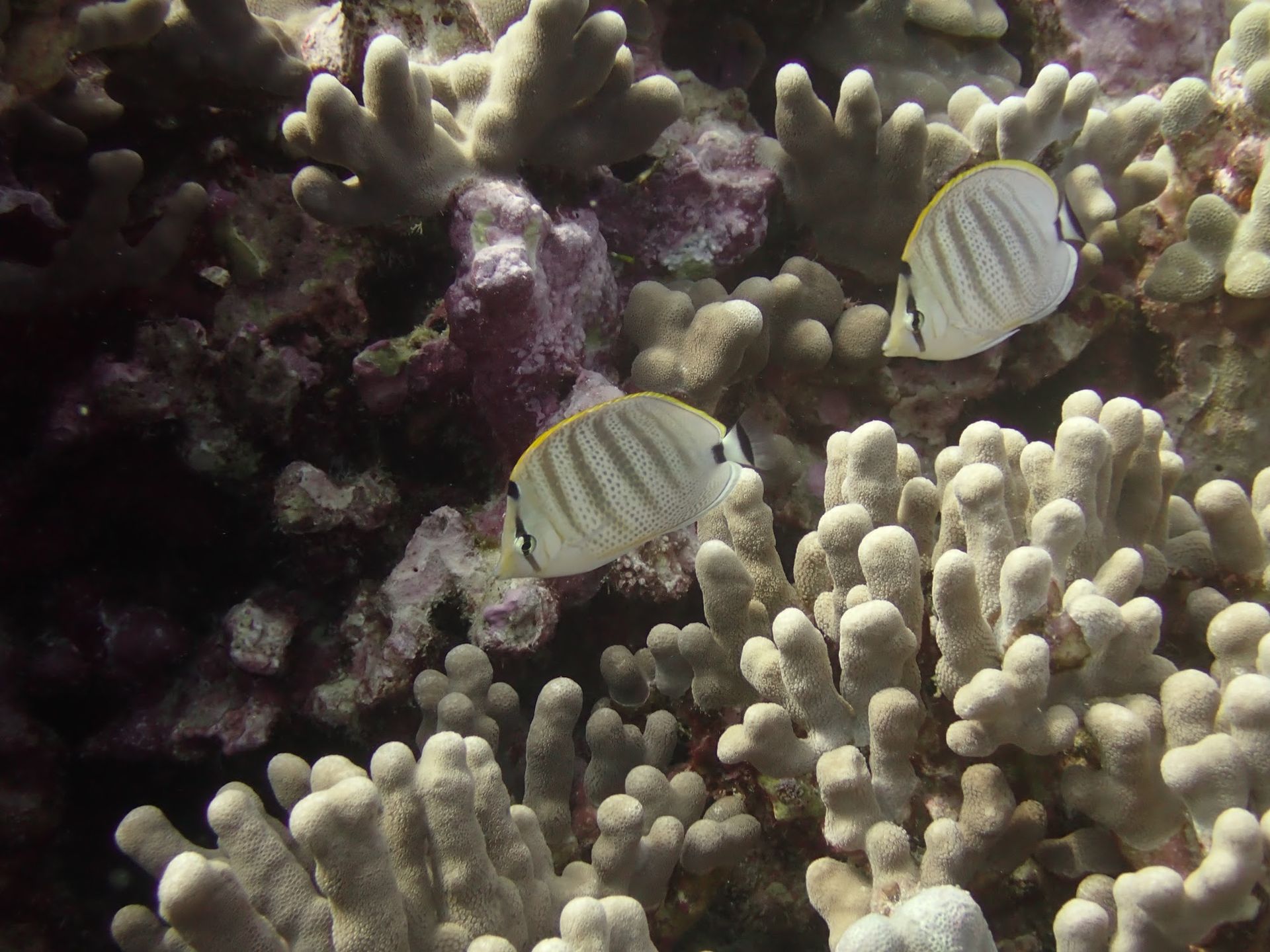
When we spend enough time diving the same reefs, it is easy to become accustomed to the fish we see on nearly every dive. The Goldring Surgeonfish, the Multiband Butterflyfish, and the Saddle Wrasse may not always inspire us to stop and take a closer look.
Yet many of these familiar fish are the product of millions of years of isolation and evolution.
On your next dive, take a moment to identify which species are endemic to Hawaiʻi. Consider how their ancestors arrived here, what allowed them to survive, and how they became uniquely Hawaiian.
What may be common on your dive today may be found nowhere else on Earth.
Join Us for Science Friday
Join us for our next Science Friday as we continue to explore the fascinating ecological stories unfolding beneath the waters of Hawaiʻi.
Science Friday is one of our Themed Dive Days . To save your spot, call us at (808) 882-7774 or book online below.
Happy Diving!
-B
Kohala Divers Science Fridays
Dive curious. Discover what others miss.
Come Dive With Us
Science Fridays happen on our two-site morning charter. Two dives, two different sites, and a mission that gives you something to look for on both of them.
You don't need to be a marine biologist or know the name of every fish. Just bring your curiosity, slow down a little, and start asking questions about what you are seeing. That is really all it takes!
There is always something happening out there. Come find out what.