Science Friday 002: Masters of Disguise

Brad • September 2, 2026

Dive curious. Discover what others miss.

Mission Recap

Sometimes the best way to survive on a coral reef is to make sure nobody notices you are there. For our second Science Friday, we went looking for critters doing exactly that. Our mission for Masters of Disguise was to observe organisms using different strategies to avoid being noticed.


Over two dives, we found marine life disappearing against rocks, changing their appearance, and even covering themselves with material from the reef.


However, camouflage isn’t always just about hiding from predators. For some animals being difficult to see helps them get close enough to catch their prey.


The Trumpetfish That Changed Before Our Eyes

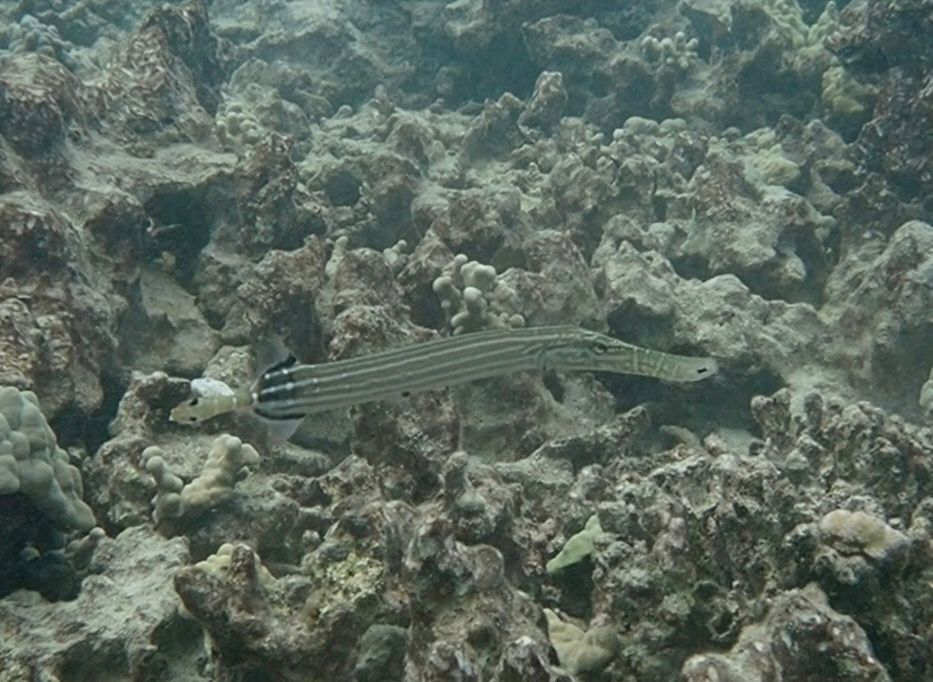
A long, narrow trumpetfish hanging vertically against the reef, its body showing lengthwise stripes and crossways bars.

Trumpetfish are strangely shaped fish. Their long, narrow bodies can make them surprisingly difficult for their prey to see when they position themselves vertically, peering into the reef. But during our dives, we watched something even more interesting. The trumpetfish appeared to change its pattern to better match its surroundings. More on this in our What We're Still Wondering section below.


An Urchin Wearing the Reef

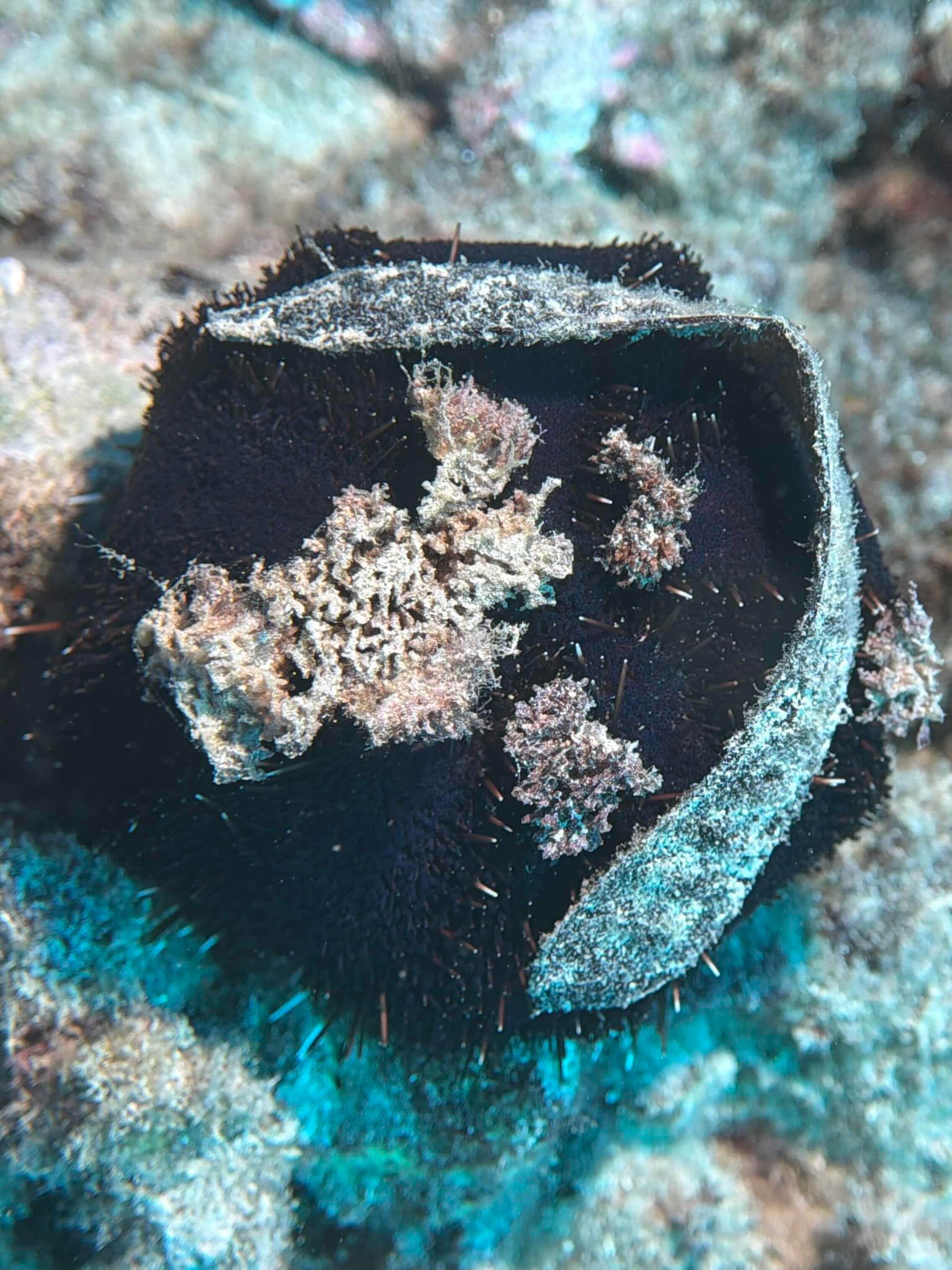
A collector urchin holding pieces of algae, shell and rubble across the top of its body

Another Master of Disguise was hiding in plain sight. We found collector urchins carrying algae and shells across the tops of their bodies. At first glance, it looks like straightforward camouflage. Collector urchins use their tube feet to pick up pieces of algae, rubble, shells, and other material and hold them over the upper surface of their bodies.


Scientists have proposed several explanations, including protection from predators, added weight to help secure them to rock in strong water movement, and UV protection.


Experimental research on collector urchins has found particularly strong evidence for the sunlight explanation. Collector urchins covered themselves more under bright conditions.


So what looked like camouflage to us could also have been collector urchins carrying their own sunshade.


The Lizardfish We Often Swim Past

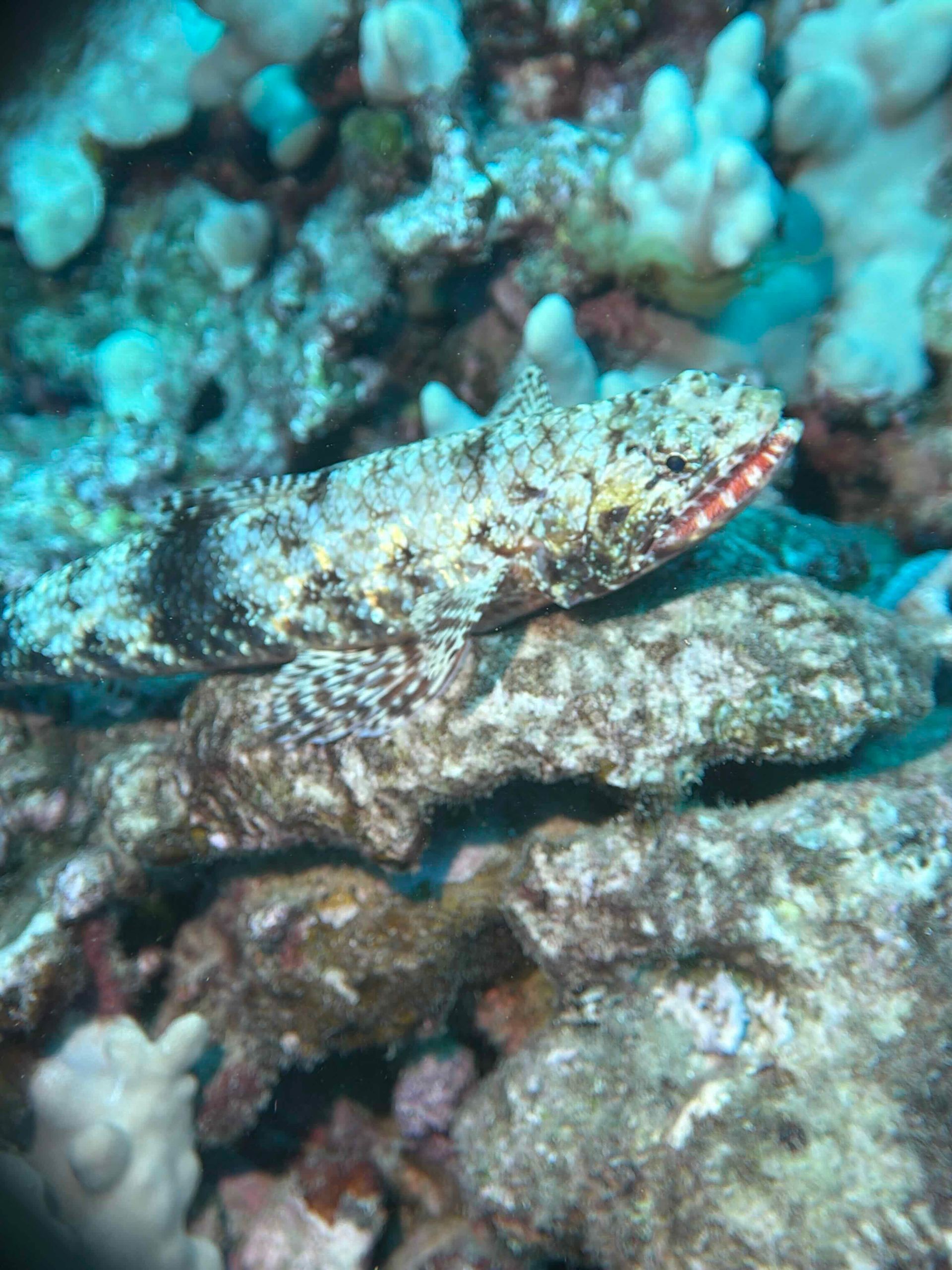
An orangemouth lizardfish lying motionless on rubble, its mottled body nearly matching the bottom beneath it

Our Hawaiian, Two Spot, and Orangemouth Lizardfishes showed us another Master of Disguise strategy. Rather than changing color in front of us or covering itself with pieces of the environment, these lizardfish were simply well matched to the bottoms they laid upon. This makes sense for ambush predators. Stay still and blend in, patiently waiting for dinner to unsuspectingly swim by.


What We're Still Wondering


Sivan raised the question, "Do trumpetfish have chromatophores?"


Trumpetfish (Aulostomus chinensis) can quickly shift from looking almost completely uniform to showing stripes that run lengthwise along the body or bars that run across it. Scientists have not yet mapped out exactly how they do this, but the best explanation is that different areas of the skin contain chromatophores that can be turned "on" or "off" as pigment spreads out or pulls together inside the cells. In other words, the stripes are probably not moving or changing direction, more likely, they are revealing different patterns that are already built into their skin. These changes seem to be controlled by the nervous system and may help trumpetfish match their surroundings while hunting or hiding.


Disappearing Isn't One Strategy


This is probably our biggest takeaway from Mission 002. The Masters of Disguise we observed weren't all doing the same thing. The trumpetfish changed its appearance, while the collector urchin covered itself, and the lizardfish blended into the rocks and rubble beneath it.


Next Science Friday:
Mission 003: The Grazer


Next Friday, September 4th, 2026 we’re going from observing critters trying not to be seen, to some of the most commonly observed daytime feeders. Our mission is to find herbivores and detritivores and compare how each removes material from the reef and are all animals we casually call “grazers” actually doing the same job? 

This mission was inspired by a question Brett brought up after our Mission 002 dive about what sea cucumbers are feeding on. Thank you Brett, we look forward to answering your question this week!


Reserve your spot today!


Science Fridays

Dive curious. Discover what others miss.

Come Dive With Us

Science Fridays happen on our two-site morning charter. Two dives, two different sites, and a mission that gives you something to look for on both of them.


You don't need to be a marine biologist or know the name of every fish. Just bring your curiosity, slow down a little, and start asking questions about what you are seeing. That is really all it takes!


There is always something happening out there. Come find out what.

A white background with a few lines on it
Turquoise parrot fish swimming over a sandy reef beside coral rocks
By Brad September 9, 2026
Dive Curious. Discover what others miss. Mission Recap There are a lot of organisms eating algae on a coral reef, but they are not all doing the same ecological job. Rather than simply looking for herbivores, our mission was to observe different grazers and compare how each one removes material from the reef. Over two dives, we came across a variety of grazers, from yellow tangs, to goldring surgeonfish, to parrotfish, to urchins. All of them interact with algae in some way, but once we began paying closer attention to how they feed, the word “grazer” became more complex. Not All Grazers Graze the Same Way Herbivory is one of the processes that helps to shape a coral reef. By removing algae, herbivores can influence how much space and light are available on the reef and which organisms are able to occupy the substrate. But different herbivores target different types of algae and remove them in different ways. Some fish crop algae from the surface, while others scrape tightly attached algal turf from hard substrate. Some browse larger fleshy algae. Sea urchins use a five-toothed feeding structure rasp material from the reef. So instead of asking, “What is eating algae?”, we began to ask a more useful questions: What does each feeding strategy do to the reef surface? Parrotfish Scraping the Reef
By Brad August 25, 2026
Dive curious. Discover what others miss. Mission Recap Something is always eating on a coral reef. We don't always get to see it happen, but if we know what to look for, we can often find the clues left behind. That was the mission for our first Science Friday: Who Ate That? Rather than simply looking for marine life, we spent two dives looking for evidence of feeding and asking a simple question: Who ate that? Reading the Reef One of the goals of Science Friday is to get us thinking about a coral reef as more than a collection of fish, invertebrates, and substrate. It is a community of organisms constantly interacting with one another. Feeding is one of the easiest ways to begin observing those interactions because even when we don't witness it first hand, often clues are left behind.
Silver fish swimming beside a large school over coral in deep blue ocean water
By Brad August 19, 2026
Dive curious. Discover what others miss.